ABSTRACT
-
Background
Health outcomes and inequalities are shaped by political processes, yet the vocabulary used to describe this relationship is applied inconsistently and has not been systematically examined. This vocabulary includes “health politics,” “politics of health,” “politics of public health,” “politics of health policy,” and “political determinants of health” (PDoH).
-
Objectives
To map how “politics” is conceptualized when these focal terms are used across the health and social science literature, and to clarify how PDoH relates to the broader health-politics vocabulary.
-
Methods
In this scoping review, we searched Scopus, Web of Science, and PubMed for articles published between 1976 and 2025 and conducted a term-in-use analysis of 457 included records (329 using politics-of-X terms; 128 using PDoH). Using directed qualitative content analysis, two independent coders classified the dominant conceptualization of each focal term into seven categories (policy process; governance and accountability; interest group politics; social movements; critical power analysis; political economy and welfare state; and ethics and normative reasoning), with almost perfect inter-rater agreement (screening κ = 0.94; primary-category κ = 0.90).
-
Results
Conceptual usage was dominated by policy process (31.3%) and critical power analysis (26.9%), which together accounted for 58.2% of records, with the remaining categories comparatively sparse. The politics-of-X and PDoH corpora shared this conceptual core in nearly equal proportion (each ≈ 58%) but differed in emphasis: PDoH was more often framed through critical power analysis and structurally oriented categories (political economy, governance), whereas politics-of-X terms more often invoked actor- and process-centered framings. Multiple correspondence analysis recovered two interpretive axes, contrasting structural/critical with agential/process usage and conceptual with applied usage.
-
Conclusions
“Health politics” operates not as a single bounded concept but as a label organized around two loosely connected conceptual traditions: an applied, process-centered one and a critical, structurally oriented one. PDoH sits within this structure as a critically and structurally inflected specialization rather than a departure from it. The resulting mid-range typology offers a shared vocabulary for more cumulative research on the political drivers of health.
-
Keywords: health politics; political determinants of health; politics of health; scoping review; conceptual typology; content analysis; public health
Introduction
Public health is unavoidably political. The distribution of disease and the conditions that produce it are shaped not only by the social determinants of health but by the political power and processes that allocate those determinants across populations (
Bambra et al., 2007;
Navarro & Muntaner, 2004;
Ottersen et al., 2014). Research on the social determinants of health has mapped the upstream causes of ill health, yet remains incomplete without an account of the political mechanisms through which those causes are generated, sustained, or reformed (
Beckfield & Krieger, 2009;
Mackenbach, 2019). Over the past two decades, public health and health-policy scholarship has increasingly drawn on political science, including concepts of institutions, governance, agenda-setting, and the policy process, to elucidate these mechanisms (
de Leeuw et al., 2014;
Greer et al., 2018). Most recently, the political determinants of health (PDoH) framework has foregrounded power and political systems as primary drivers of population health and inequities (
Dawes, 2020;
Kickbusch, 2015;
McKee & Stuckler, 2018).
As this literature has grown, so has its vocabulary. Expressions such as “health politics,” “politics of health,” “politics of health policy,” and “politics of public health” are now used across epidemiology, health policy, political science, and sociology to name the political dimensions of health, alongside the more recent “political determinants of health.” These terms travel across disciplines, encompassing institutional processes, interest-group conflict, structural power, and normative critique, marking health politics as a multidimensional domain rather than a single, bounded concept (
Bambra et al., 2007;
Carpenter, 2012). Indeed, health politics has recently been advanced as a distinct, interdisciplinary field, defined as the study of how power, institutions, and political conflict shape health and health equity (
Chung & Muntaner, 2026). Yet they have not been examined systematically, and their meanings remain diffuse.
Three interrelated gaps follow. First, the terms are applied inconsistently to distinct phenomena, from the dynamics of policymaking to the structures of political economy, often without explicit boundaries. This raises the risk of conceptual stretching, whereby a concept expands to cover disparate referents while losing definitional content (
Sartori, 1970). Second, little is known about how these terms are used in practice. Prior work has largely advanced programmatic arguments for taking politics seriously, or has synthesized the empirical association between political variables and health outcomes (
Muntaner et al., 2011); the terms themselves have not been examined across disciplines and time. It thus remains unclear whether the vocabulary shares a conceptual core or fragments into discipline-specific meanings. Third, there is no empirically grounded framework organizing these understandings. Political science offers a rich repertoire of middle-range theories (
Merton, 1968), but their uptake in public health has been uneven and fragmented (
Greer et al., 2018).
Addressing these gaps requires more than conceptual clarification. It also requires knowing whether the different senses of “health politics” correspond to distinct intellectual traditions or simply coexist without clear organization —that is, how conceptual meanings map onto the structure of the field. The rise of PDoH sharpens this question. Because PDoH advances a more explicitly structural and power-centered framing, whether it is a subset, an extension, or an alternative to the broader health-politics vocabulary remains an open empirical question.
This scoping review addresses these questions by examining how “health politics” and related expressions have been used across the literature from 1976 to 2025. Focusing on the term-in-use, we classify how “politics” is conceptualized in titles and abstracts using a structured framework of seven categories that span policy processes, governance, political actors and movements, critical power analysis, political economy, and normative reasoning (see Methods). A comparator corpus on PDoH is analyzed using the same framework to assess conceptual overlap, specialization, and divergence. In doing so, it offers one of the first systematic accounts of how the field’s core vocabulary is actually used, develops a mid-range conceptual typology, and locates PDoH within it, supplying what a literature dominated by programmatic argument has lacked.
Methods
Methodologically, the study pairs a scoping review for corpus construction and characterization with a directed qualitative content analysis for mapping how the focal terms conceptualize “politics.” This scoping review was reported based on the PRISMA-ScR (Preferred Reporting Items for Systematic reviews and Meta-Analyses extension for Scoping Reviews) guidelines (
Tricco et al., 2018). The completed PRISMA-ScR checklist is provided as a
supplementary file. The study design is anchored in the methodological framework originally proposed by
Arksey & O’Malley (2005) and further refined by the subsequent recommendations of
Levac et al. (2010). Additionally, the JBI (Joanna Briggs Institute) manual for evidence synthesis served as a technical reference to ensure methodological rigor (
Aromataris & Munn, 2020). No review protocol was prospectively registered for this study. Consistent with PRISMA-ScR guidance for scoping reviews, no formal critical appraisal of individual sources of evidence was conducted.
The inclusion and exclusion criteria were predefined to ensure a systematic selection of relevant literature. To be eligible for inclusion, documents had to be: (1) Original research articles or review articles, (2) Published in English, (3) Published between 1976 and 2025. One record carried a 2026 cover date because it had been published early online (early access) and was already retrievable at the final search on January 26, 2026; as a formally accepted journal article rather than a preprint, it was retained and counted in the 2021–2025 interval. Studies were excluded if they were preprints (due to inconsistent formal publication dates) or documents where the specified keywords were not detected within the text. Documents were also excluded if the full text was not accessible to the researchers for further analysis; if the focal term, although present, was used only peripherally rather than substantively; if no abstract was available, so that the presence and use of the focal term could not be verified; or if the document addressed exclusively technical medical procedures or clinical applications without reference to their social or political context.
Information Sources and Search Process
We used three databases to identify relevant literature: Scopus, Web of Science, and PubMed. The initial search was conducted on January 5, 2026. Following this, a final refined search was performed on January 26, 2026, incorporating adjusted search filters (language, document type, and full-text availability) to enhance the precision of the retrieved data. The full search strings for each database and corpus, together with the filters applied and the number of records identified, are provided in
Supplementary Table S1.
To capture the multifaceted nature of health politics and its academic diffusion, we developed a stratified search strategy resulting in two corpora:
Corpus A (Strict Corpus): Comprised of documents where the primary terms (“health politics,” “politics of health,” “politics of health policy,” and “politics of public health”—hereafter, “politics-of-X” terms) appeared in the title or abstract. This corpus aims to analyze the substantive discourse and practical usage of these terms within the text.
Corpus B (PDoH-specific Corpus): Specifically designed to track the emergence and subsequent development of the term “political determinants of health.” Two complementary search variants were used—one requiring the term in the title or abstract, the other admitting it in the title, abstract, or keywords—and their results were pooled and deduplicated (full search strings in Supplementary Table S1).
Selection Process
The selection and refinement of the retrieved literature proceeded in two distinct stages, beginning with the removal of duplicate records. Initially, duplicates were automatically identified and removed using the EndNote deduplication feature. To ensure dataset integrity, two researchers then manually reviewed the records, eliminating remaining duplicates by cross-referencing bibliographic metadata (DOIs, authors, and publication titles). One record contained both a politics-of-X term and “political determinants of health” and was therefore retrieved by both corpus searches. To avoid double counting, it was retained once, in Corpus A, with its term form recorded as combined (“health politics; political determinants of health”) and classified under Multiple /other.
Screening Process
In the initial screening, two researchers independently screened the titles and abstracts of all unique records against the eligibility criteria; disagreements were resolved through discussion. Because preprints and early-access versions often bypass initial database filters, records published outside the 1976–2025 range were also identified and removed manually at this stage. The distribution of exclusion reasons—ineligible publication year, ineligible document type, non-English text, focal term not detected in the designated fields, lack of relevance to the research topic, inaccessible full text, and unavailable abstract—is reported in the Results and in
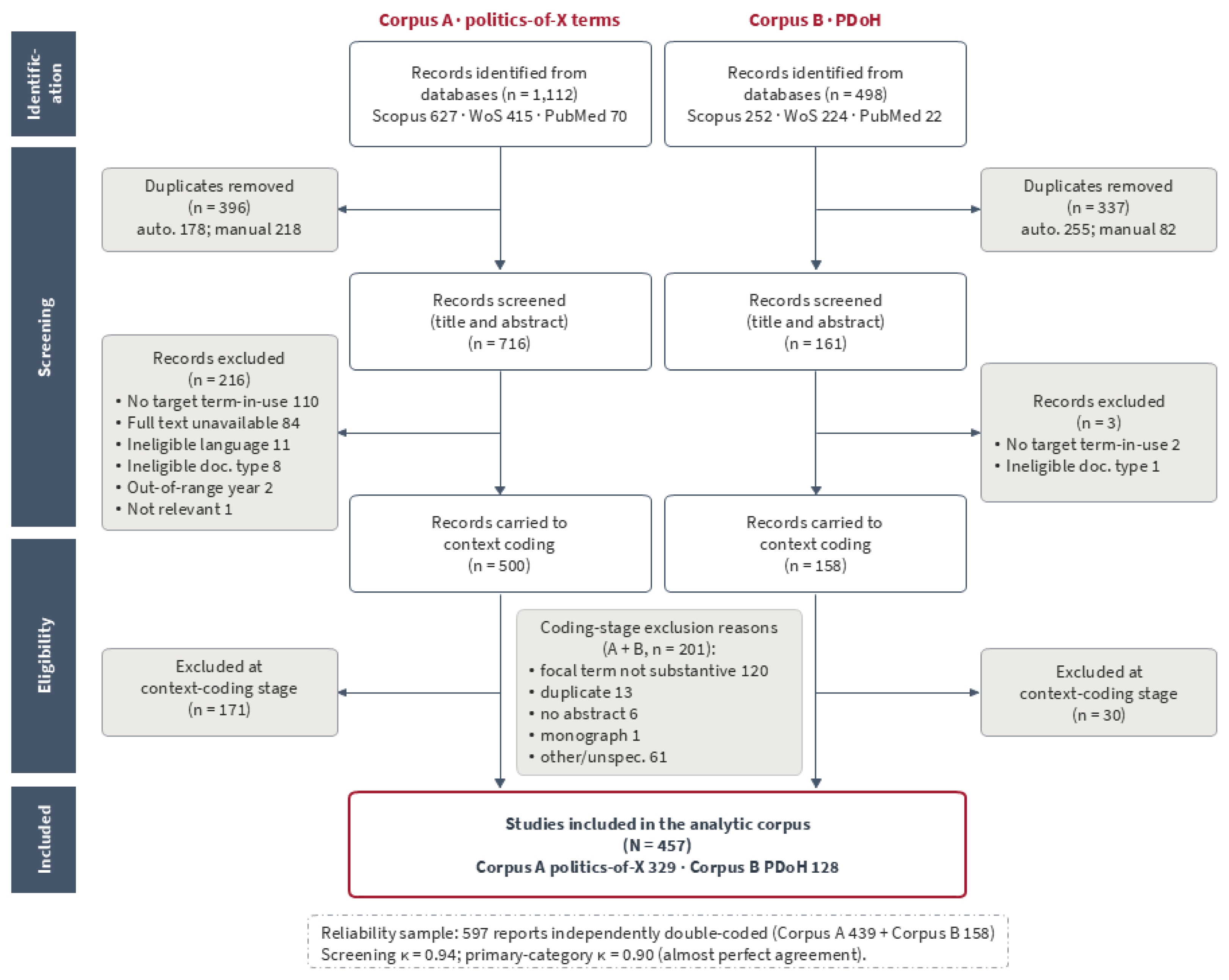
Figure 1.
Unit of analysis and analytic objective
We conducted a term-in-use analysis to identify how “politics” is conceptually invoked in the literature. For Corpus A (n = 329), the object of interpretation was the meaning of “politics” as conveyed by the use of the terms “health politics,” “politics of health,” “politics of health policy,” and “politics of public health” in titles and abstracts. For Corpus B (n = 128), the focus was the conceptual meaning of PDoH as used in titles and abstracts. The unit of analysis was the individual article, and coding was conducted at the article level. Rather than classifying studies by topic, the analysis sought to determine what dimension of politics the focal term denotes in context, reflecting a term-in-use approach to conceptual clarification.
Development of the coding framework
We developed a structured conceptual framework to capture recurring dimensions through which “politics” is articulated in public health and health policy research. Drawing on political science and public health literatures (
Bambra et al., 2007;
Greer et al., 2018;
Kickbusch, 2015), the framework comprised seven substantive categories (policy process (
Sabatier & Weible, 2014;
Walt & Gilson, 1994); governance and accountability (
Greer et al., 2016;
Greer et al., 2019); interest group politics (
Bachrach & Baratz, 1962;
Olson, 1965;
Schattschneider, 1960); social movements (
Brown et al., 2004;
Tarrow, 2011); critical power analysis (
Foucault, 1978;
Gramsci, 1971;
Lukes, 2005); political economy and welfare state (
Bambra, 2011;
Esping-Andersen, 1990;
Navarro, 2007); and ethics and normative reasoning (
Daniels, 2008;
Powers & Faden, 2006)), alongside two residual categories (
Other and
Unclear).
The seven categories are not all of the same analytic kind. Five identify substantive domains of politics drawn primarily from political science and comparative welfare-state research (policy process; governance and accountability; interest group politics; social movements; and political economy and welfare state), whereas two identify crosscutting analytic registers drawn from adjacent traditions: critical power analysis, rooted in critical social theory, and ethics and normative reasoning, rooted in moral and political philosophy. Because a record may combine a substantive domain with a critical or normative treatment, the single primary code was assigned by the dominant conceptualization, so the critical and normative categories absorb work spanning several domains.
Each category was defined through an integrated specification of conceptual definition, analytic focus, and indicative terms (
Supplementary Table S2). Indicator terms were used to support interpretation but did not determine classification; coding was based on the overall conceptual role of the focal term within the title and abstract.
Coding approach
Coding focused on identifying the primary conceptual meaning of the focal term in context. Each article was assigned a single category representing the dominant way in which “politics” (or PDoH) was operationalized. This approach reflects the assumption that, although multiple dimensions of politics may be present, one typically serves as the principal analytic framing. The single-code approach reflects this interpretive premise and allows systematic comparison of how the focal term is deployed across the corpus. Where a secondary dimension was also discernible, it was recorded but not used in primary analyses. In addition to the primary (and, where discernible, secondary) code, each record was flagged as a definitional piece when the focal term itself was the object of explicit conceptual elaboration rather than being invoked in passing. Each record was additionally coded for descriptive attributes used in corpus characterization—study type (empirical designs, theoretical/conceptual work, and perspective-style articles), health domain, and unit of analysis (see
Appendix).
In practice, coding required distinguishing the meaning of the focal term from the broader substantive content of the article. For example, studies addressing inequality were not classified as political economy unless the focal term explicitly referred to structural distributional arrangements, welfare systems, or resource allocation. Similarly, references to rights or equity were coded as ethics and normative only when the term was used in a clearly evaluative or moral sense.
Where abstracts invoked multiple dimensions, the dominant frame was identified based on what the article primarily treated as “politics.” For instance, discussions of financing reform were coded as policy process when emphasizing reform dynamics or implementation, but as political economy when emphasizing structural redistribution or fiscal systems.
Treatment of ambiguity and consistency across corpora
Because the analysis relied on titles and abstracts, not all records provided sufficient conceptual detail. In such cases, coding followed a conservative approach: when the meaning of the focal term could not be determined with confidence, the record was classified as Unclear.
This rule was applied consistently across both corpora. In particular, when “political determinants of health” appeared only as a generic label, background reference, or rhetorical framing without substantive elaboration, it was coded as Unclear. This ensured that the analysis captured conceptual usage rather than nominal invocation, which is especially important given the broad and sometimes diffuse use of PDoH in the literature.
Codebook refinement and calibration
The coding framework was refined iteratively through pilot coding. Initial coding of a subset of records was used to clarify category boundaries and standardize interpretation, particularly in areas of conceptual overlap, such as between policy processes and governance, or between power relations and institutional structures.
These refinements were incorporated into the final codebook (
Supplementary Table S2; the full codebook is provided in the
Appendix), and remaining ambiguities were resolved through iterative comparison and discussion; illustrative coding decisions with their rationale are provided in
Supplementary Table S3. This process ensured that coding decisions were conceptually consistent while remaining sensitive to variation in how “politics” is articulated across disciplines and time.
Double-coding and inter-rater reliability
To assess coding reliability, all records were independently double-coded; the lead coder coded blind to the second coder’s assignments to prevent anchoring and retained final responsibility for code assignment. Inter-rater reliability was computed on the independent codes using Cohen’s κ for the screening (include/exclude) decision and for the primary category. The resulting agreement statistics are reported in the Results. Disagreements were resolved through discussion and used to refine the codebook’s decision rules, which were then applied to the full corpus.
Analytical use of coding
The resulting category assignments were used to examine the distribution of conceptual meanings of politics across the literature and to compare patterns between health politics terminology and the PDoH framework. By capturing the dominant conceptual framing of each record, the analysis provides an empirical basis for identifying both shared conceptual cores and systematic differences in how politics is understood within public health research.
Statistical Analysis
Conceptual usage was summarized descriptively as counts and percentages of the primary category, overall and separately by corpus and by focal-term form. To assess whether the focal-term form or the corpus was associated with the primary conceptual category, we used chi-square (χ2) tests of independence and reported Cramér’s V as the effect size. Given the descriptive aim of the review and the presence of sparse cells, these tests are interpreted as indicators of association rather than as confirmatory hypothesis tests. To characterize the conceptual breadth of each focal term, we computed a normalized Shannon entropy index over its distribution across the eight reported categories (the seven substantive categories plus the residual Other), rescaled to the unit interval, where 0 denotes concentration in a single category and 1 an even spread across all categories.
To explore the latent structure underlying the coded attributes, we conducted a multiple correspondence analysis (MCA) of three categorical variables (primary category, focal-term form, and definitional status), retaining the first two dimensions and reporting the proportion of total inertia explained by each. The dimensions are interpreted descriptively, as axes of association rather than as a measurement model. Conceptual adjacency among categories was examined from the secondary codes as aggregate primary-to-secondary co-occurrence (
Supplementary Table S4), and the stability of this structure across the two coders was assessed using the Spearman rank correlation (ρ) between their independently produced adjacency profiles. All analyses were conducted in Python (pandas and SciPy, with the prince package for the multiple correspondence analysis). Where reported, statistical significance was evaluated at a two-sided α = .05.
Results
Across the two analytic corpora (the politics-of-X corpus, designated Corpus A, and the PDoH corpus, designated Corpus B), comprehensive searches of Scopus, PubMed, and Web of Science identified 1,610 records published between 1976 and 2025. After removal of duplicates and title and abstract screening, the retained records were carried forward to context coding; the full selection flow is detailed below and in
Figure 1.
In Corpus A, we found 1,112 records, specifically 627 from Scopus, 70 from PubMed, and 415 from Web of Science. Before the screening process, 396 duplicates were removed, which consisted of 178 records identified automatically and 218 records identified through manual deduplication. We screened the remaining 716 records, of which 216 reports were excluded for not meeting the inclusion criteria. The primary grounds for exclusion in Corpus A were the absence of the target term-in-use (n = 110), lack of full-text accessibility (n = 84), and ineligible language (n = 11). Other reasons were ineligible document types (n = 8), publication years outside the specified range (n = 2), and lack of relevance to the research topic (n = 1). This process resulted in a final inclusion of 500 reports.
In Corpus B, we found 498 records, with 252 from Scopus (across the two search variants), 224 from Web of Science (across the two search variants), and 22 from PubMed. We removed 337 records before screening, involving 255 automated and 82 manual duplicate removals. Of the 161 records screened, only 3 were excluded. These exclusions were due to the target term-in-use not being detected (n = 2), and an ineligible document type (n = 1). This yielded 158 reports for Corpus B.
From the records retained after screening (500 politics-of-X and 158 PDoH), context coding was applied to determine how the focal term was conceptually used. Coding was performed on abstracts, with full texts consulted whenever an abstract was insufficient to judge conceptual usage. Accordingly, records whose full text was inaccessible in such ambiguous cases could not be reliably coded and were excluded. During coding, 61 politics-of-X records were removed before double-coding for other or unspecified reasons, so that 439 politics-of-X and 158 PDoH records (597 in total) were independently double-coded. Of these, 110 politics-of-X and 30 PDoH records were excluded, chiefly because the focal term was not used substantively (n = 120), with smaller numbers removed as duplicates (n = 13), for lacking a codeable abstract (n = 6), or as a monograph misclassified as an article (n = 1), yielding the final analytic corpus of 329 politics-of-X and 128 PDoH records (N = 457) (
Figure 1). The full list of included records, with corpus, focal-term form, and primary category, is provided in
Supplementary Table S5.
Inter-rater reliability was high. On the 597 independently double-coded records, screening (include/exclude) agreement was 98.0% (κ = 0.94, 95% CI 0.91–0.97), and agreement on the primary category among jointly included records was 92.3% (κ = 0.90, 95% CI 0.87–0.93; n = 454), both indicating almost perfect agreement (
Landis & Koch, 1977). The primary-category κ was computed on the 454 records that both coders independently included, the only records with two independent primary codes. The final analytic corpus (N = 457) adds 4 records resolved to inclusion by consensus and removes 1 excluded on adjudication.
Consistent with the eligibility criteria, which restricted inclusion to original research and review articles, the 329 records of Corpus A comprise 286 articles (86.9%) and 43 reviews (13.1%).
Across the 329 records, the focal-term forms were distributed unevenly. “Health politics” (n = 119; 36.2%) and “politics of health” (n = 107; 32.5%) were the most common, together accounting for more than two-thirds of the corpus. These were followed by other “politics-of-health-X” constructions (n = 47; 14.3%) and “politics of public health” (n = 40; 12.2%), while “politics of health policy” (n = 9; 2.7%) and records combining more than one focal term (n = 7; 2.1%) were comparatively rare.
Temporal Publication Trends
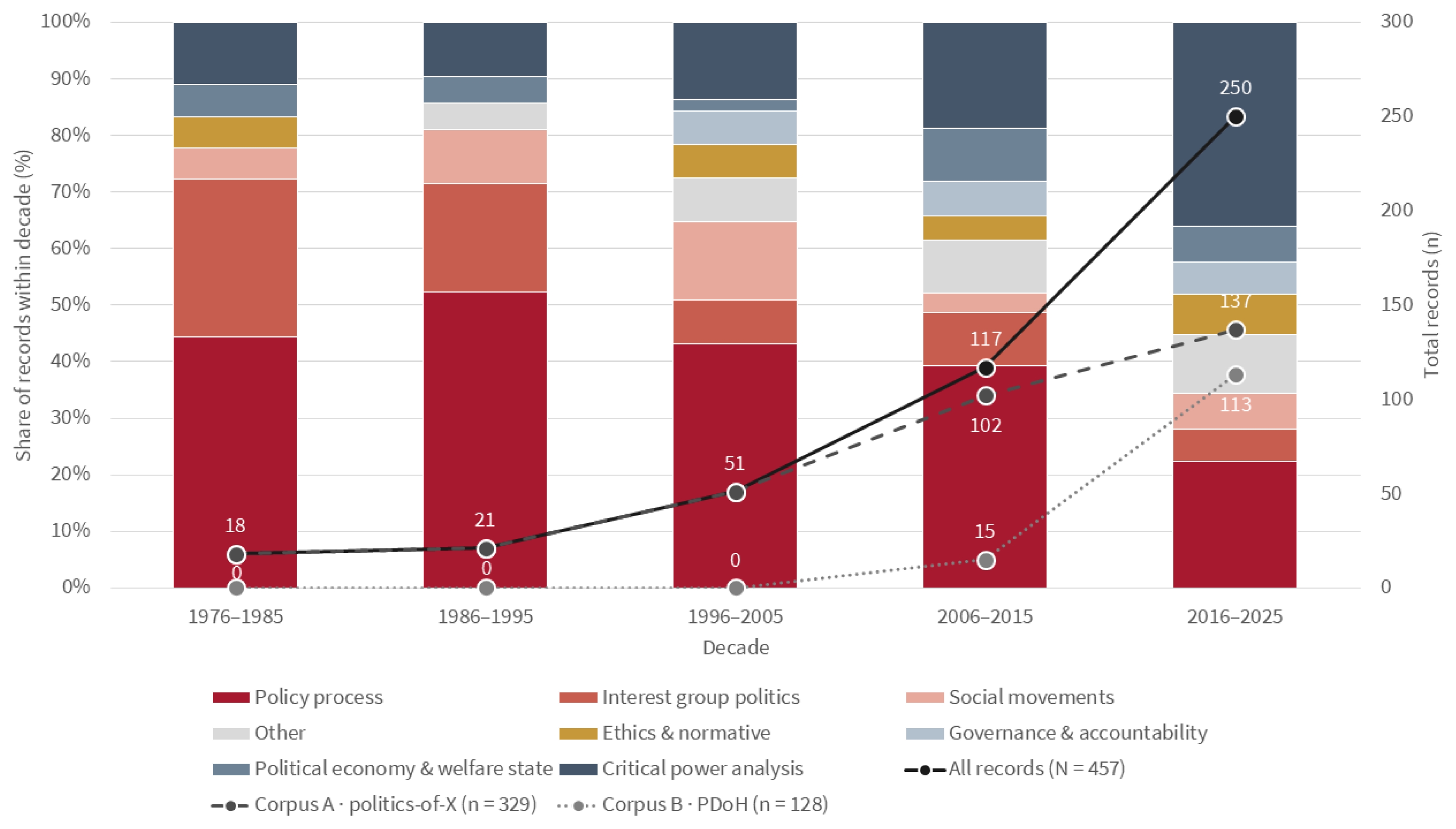
The distribution of Corpus A across 1976–2025 shows a steady expansion of the literature over the five-decade period (see
Figure 2 for the decadal trajectories of the two corpora). Output was modest through the first three intervals, with 8, 10, and 4 records in 1976–1980, 1981–1985, and 1986–1990, before rising to 17 records in each of the 1991–1995 and 1996–2000 intervals.
Growth accelerated thereafter, from 34 records in 2001–2005 to 45 in 2006–2010 and 57 in 2011–2015. The two most recent intervals show the highest output, with 71 records in 2016–2020 and 66 in 2021–2025.
Evolution of Terminology Usage
The relative prominence of the focal terms shifted over time (
Supplementary Table S6). In the earliest interval (1976–1980), “politics of health” predominated, used in 4 records against a single use of “health politics.” The two terms grew in parallel and were level by 2001–2005 (12 each); thereafter “health politics” became the leading form, rising to 24 occurrences in 2011–2015 (versus 12 for “politics of health”) and remaining dominant in the two most recent intervals, with 27 occurrences in each.
“Politics of public health” remained a steady minor presence, peaking at 9 occurrences in 2021–2025, whereas “politics of health policy” stayed marginal throughout, never exceeding four occurrences in any five-year interval.
Bibliographic Characteristics of Corpus B
Corpus B comprises the 128 records that use “political determinant( s) of health”: 115 articles (89.8%) and 13 reviews (10.2%), reflecting the same document-type restriction.
Temporal Publication Trends
Reflecting the recency of the term, Corpus B is concentrated in the most recent two decades; no records predate 2006 (
Figure 2). Output was 5 records in 2006–2010 and 10 in 2011–2015. Growth then accelerated sharply, with 27 records in 2016–2020 and 86 in 2021–2025 (the latter including one early-access record dated 2026). The 2016–2025 decade thus accounts for 113 of the 128 records (88%), underscoring how recently the term has entered widespread use.
Evolution of Terminology Usage
The trajectory of “political determinant(s) of health” mirrors this pattern (
Supplementary Table S6): effectively absent before 2006, the term was used only sporadically through 2015 and then rose steeply to its peak in the most recent interval, reflecting the rapid consolidation of the terminology following its wider uptake around 2020.
The 457 records appeared in 271 distinct journals, and publication was widely dispersed across this set (
Supplementary Table S7). The single most frequent venue was the
Journal of Health Politics, Policy and Law (n = 36; 7.9%), followed by
Social Science & Medicine (n = 27; 5.9%) and
Global Public Health (n = 12; 2.6%). The ten most frequent journals together accounted for 128 records (28.0%), whereas the large majority (214 of 271 journals, 79.0%) contributed only a single record. This long-tailed distribution indicates that, although a small set of politics- and policy-oriented journals anchors the field, the focal terms are used across a broad and heterogeneous range of public health and social science venues.
Conceptual usage was also patterned by venue (
Supplementary Table S7). Among the most frequent journals, the
Journal of Health Politics, Policy and Law was dominated by policy-process usage (20 of 36 records), with critical power analysis rare (3 records). Conversely, explicitly critical and social-scientific venues carried predominantly critical-power usage, including
Critical Public Health (6 of 7),
Anthropology & Medicine (3 of 3), and
Sociology of Health & Illness (3 of 3). Grouping these identifiable venues, policy- and applied-policy journals (
JHPPL, Health Affairs, Health Economics, Policy and Law; n = 46) were 52% policy process versus 7% critical power, a balance nearly reversed in the critical and social-theoretic journals (n = 16; 12% vs. 88%), whereas
Social Science & Medicine, the single largest venue (n = 27), spanned both poles together with social movements. This pattern is descriptive and limited to the most frequent venues. A systematic analysis of all 271 journals is beyond the scope of the present review.
Throughout this section, the distributional results serve as the primary evidence and the correspondence analysis provides an exploratory map.
Overall distribution of conceptual categories
Across the 457 records in the analytic corpus (329 politics-of-X records and 128 PDoH records), the conceptualization of politics was distributed unevenly across the seven categories. Policy process was the most frequent primary conceptualization (n = 143; 31.3%), followed by critical power analysis (n = 123; 26.9%); together these two categories accounted for 58.2% of the corpus. The remaining records were distributed across Other (n = 42; 9.2%), interest group politics (n = 38; 8.3%), social movements, and political economy and welfare state (each n = 30; 6.6%), ethics and normative (n = 27; 5.9%), and governance and accountability (n = 24; 5.3%). Although the literature spans the full conceptual range, the focal terms thus most often denote either the dynamics of policymaking (e.g.,
Fox & Reich, 2015) or the structural and constitutive operation of power (e.g.,
Jones, 2019).
Conceptual breadth of the term forms
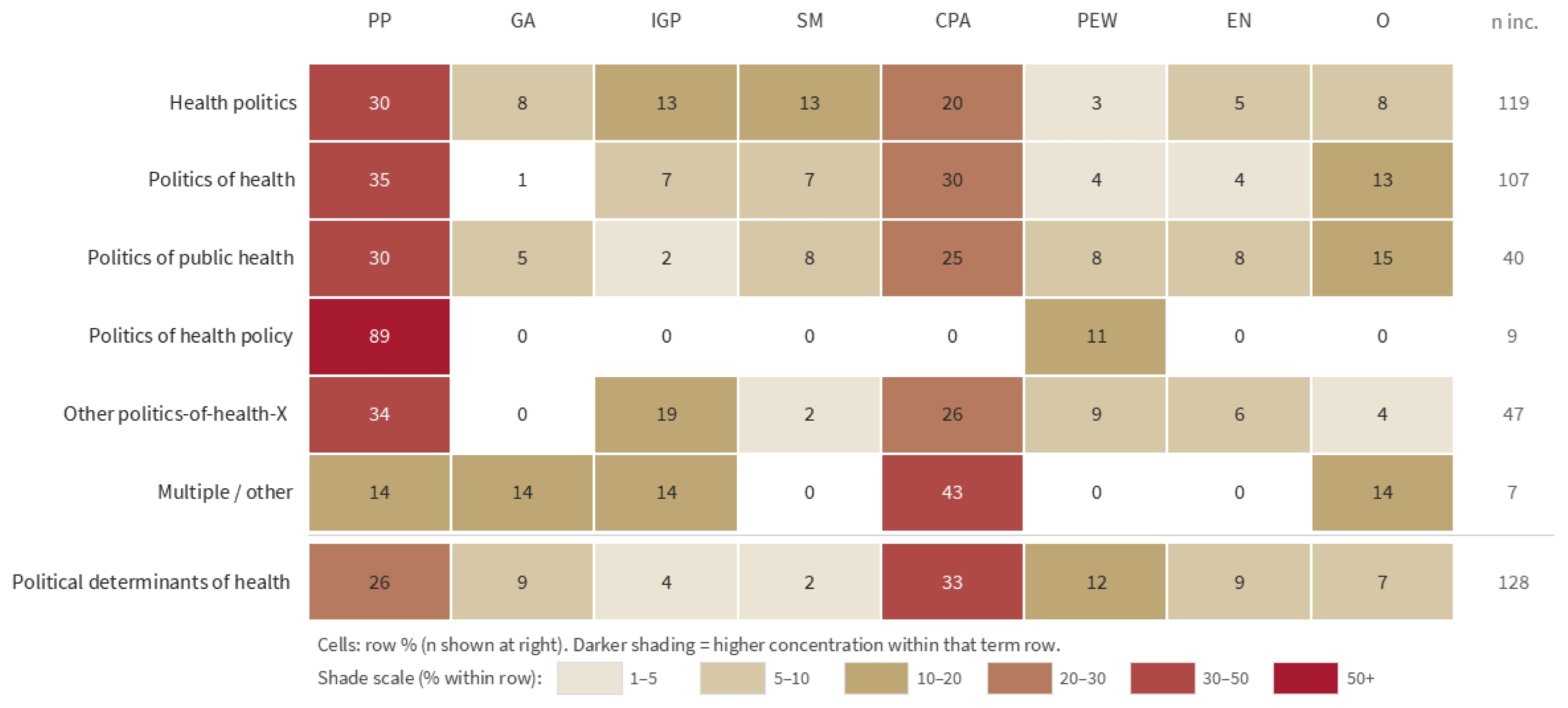
The seven term-forms also differed in conceptual breadth (
Figure 3). Treating each term’s distribution across the eight reported categories (the seven substantive categories plus the residual Other) as a profile and summarizing its dispersion with a normalized entropy index (0 indicates concentration in a single category; 1 indicates an even spread), “politics of health policy” emerged as the narrowest term (entropy = 0.17; 89% policy process), functioning almost as a synonym for policy analysis. By contrast, the remaining terms were all broadly dispersed, with entropies clustering in a narrow band (“politics of health,” 0.80; PDoH, 0.85; “politics of public health,” 0.87; “health politics,” 0.90). The meaningful contrast is thus not among these broad terms, whose conceptual breadth is essentially comparable, but between all of them and the narrowly focused “politics of health policy.” The overall association between term-form and primary category was statistically significant (χ
2 = 82.8, p < .001) though modest in magnitude (Cramér’s V = 0.17), indicating that the choice of term is informative of, but only loosely coupled to, conceptual meaning. Terminological choice thus signals the breadth of a study’s conceptual commitment, from a focused policy-analytic usage to an open and contested umbrella.
Shared core and specialization across the two corpora
Comparison of the two corpora revealed a shared conceptual core alongside systematic specialization (
Table 1). Both were anchored by the same two dominant categories, policy process and critical power analysis, which together accounted for a comparable share in each (politics-of-X, 58.1%; PDoH, 58.6%), indicating substantial overlap rather than conceptual divergence. The two diverged, however, in emphasis. In the politics-of-X corpus, policy process was modal (33.4%) and actor- and agency-centered conceptualizations were comparatively prominent: interest group politics (10.0%), social movements (8.5%), and Other (10.0%). In the PDoH corpus, by contrast, critical power analysis was modal (32.8% vs. 24.6%), and structurally oriented categories were over-represented (political economy and welfare state, 11.7% vs. 4.6%; governance and accountability, 8.6% vs. 4.0%; and ethics and normative, 8.6% vs. 4.9%), while actor- and movement-centered categories were correspondingly under-represented (interest group politics, 3.9%; social movements, 1.6%). PDoH thus appears less as a conceptually distinct construct than as a structurally and critically inflected specialization within the broader health-politics literature. This contrast was statistically reliable: the association between corpus and primary category was significant (χ
2 = 28.9, p < .001; Cramér’s V = 0.25, a moderate effect). The two corpora also differed in how explicitly the focal term was conceptualized rather than merely invoked. Definitional pieces were four times more common in the PDoH corpus than among politics-of-X terms (17.2% vs. 4.3%), and were concentrated in the critical power, governance (e.g.,
Fischer et al., 2024), and ethics (e.g.,
Dawes, 2018) categories (roughly 11–13% each) while remaining rare in policy process and interest group politics (0–5%). Conceptual theorizing of the term thus clusters in PDoH and the critical-structural categories, whereas policy-process and actor-centered work tends to deploy the term instrumentally.
Finally, an identifiable subset of PDoH records operationalized politics as a measured exposure regressed on health outcomes—for example, county unincorporation on life expectancy (
Gomez-Vidal et al., 2024), partisan polarization on individual-level mortality (
Nayak et al., 2024), political factors on progress toward the Millennium Development Goals (
Atti & Gulis, 2017), and state political indicators on health outcomes (
Krieger et al., 2024)—without an accompanying analytic lens of process, power, governance, or political economy. These records did not cluster in a single category, appearing under Other and under political economy alike.
Latent structure: a two-axis map
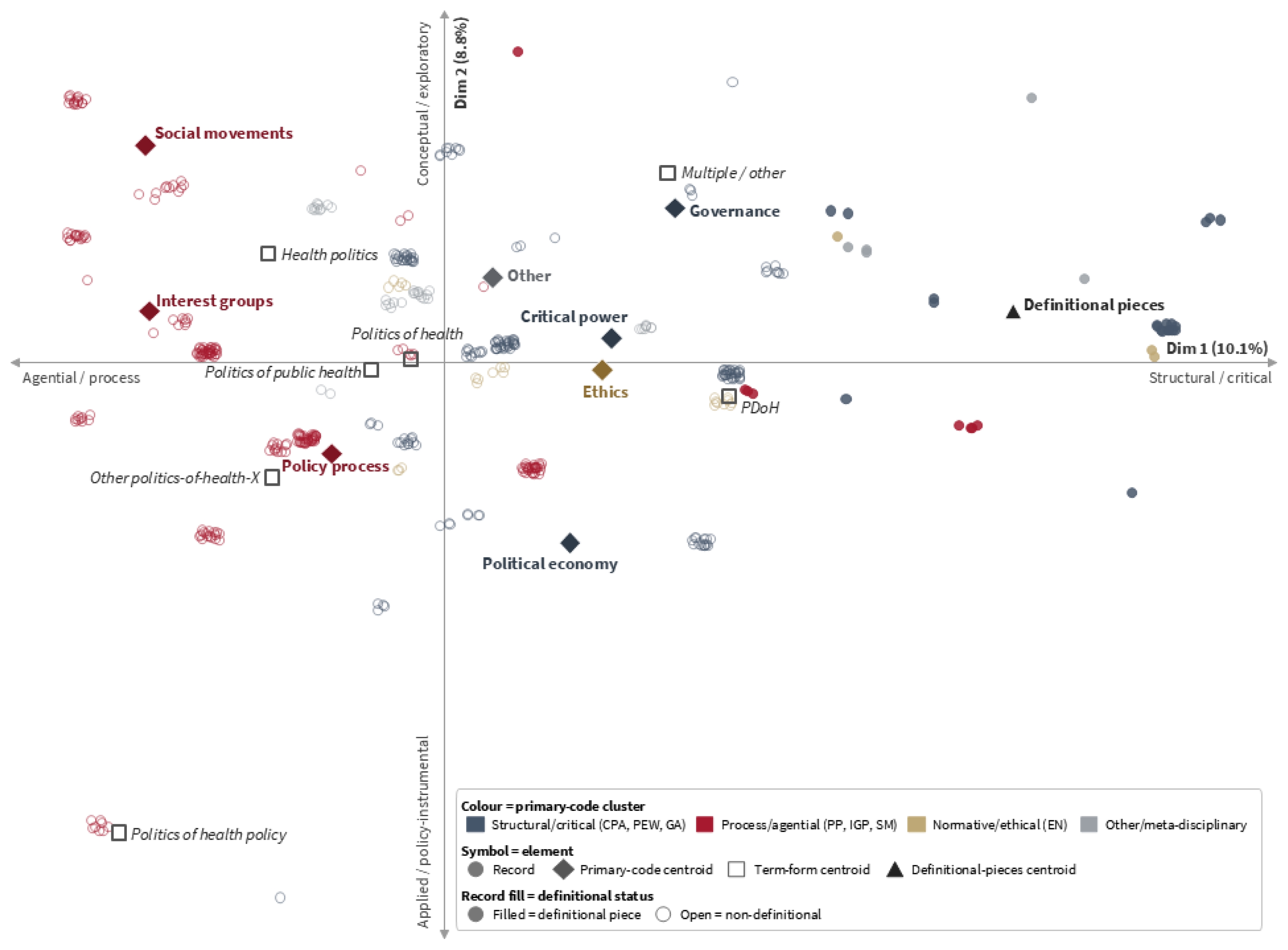
To examine the latent structure underlying these categories, we conducted a multiple correspondence analysis of three coded variables: primary category, focal-term form, and definitional status. Whereas the seven categories are a priori dimensions specified for the directed content analysis, the two MCA axes are a post hoc empirical summary of how those categories co-occur. The two layers thus operate at different levels of granularity, and the broader two-axis structure reflects the heterogeneity in how “politics” is used rather than a limitation of the category scheme. The first two dimensions, which jointly accounted for 18.9% of the total inertia (Dimension 1, 10.1%; Dimension 2, 8.8%), described a coherent two-axis typology. The first dimension distinguished agential, process-oriented conceptualizations (policy process, interest group politics, social movements) from structural and constitutive ones (critical power analysis, political economy, governance). The second distinguished applied, policy-instrumental usage from conceptual and exploratory usage. PDoH and the structurally oriented categories projected toward the structural pole of the first dimension, consistent with the distributional findings above (
Figure 4; term-by-category patterns in
Figure 3). Notably, governance and accountability projected to the structural extreme of the first dimension, indicating that in this corpus governance is invoked less as administrative process than as a vocabulary of structural power arrangements. The MCA is used descriptively, as an exploratory map of co-occurrence among coded attributes. Positions should be read as relative proximities rather than absolute magnitudes, and the two dimensions summarize the dominant (though not exhaustive) axes of association.
Beyond the primary code, coders recorded a secondary conceptual dimension where one was discernible. Because the secondary codes were not subjected to the final adjudication applied to the primary code, we treat them as exploratory and report only aggregate co-occurrence rather than record-level classifications. A distinct secondary dimension was present in 208 records (45%). The primary-to-secondary co-occurrence (
Supplementary Table S4) shows that policy process functioned as a connective hub: the agential and institutional categories (interest group politics, governance and accountability, political economy) most often took policy process as their secondary dimension. Critical power analysis, by contrast, was adjacent chiefly to the normative and movement categories (ethics and normative, social movements) and to governance. Notably, despite being the two largest categories, policy process and critical power analysis co-occurred directly in only about 19 records, far fewer than their size alone would predict, reinforcing the picture of two weakly connected conceptual clusters. This aggregate structure did not depend on which coder produced it: although the two coders’ record-level secondary assignments agreed only moderately, the adjacency profiles each coder produced independently were almost identical (Spearman ρ = 0.97 across category pairs, with six of the seven strongest pairs shared). The reported co-occurrence pattern therefore does not hinge on how individual coding disagreements are resolved.
The conceptual clusters also differed in methodological texture. Most categories were predominantly empirical, but critical power analysis and, especially, ethics and normative drew more heavily on theoretical/conceptual and perspective-style articles—records indexed as research articles whose content is primarily conceptual or argumentative— which together comprised roughly a quarter to a third of each, whereas social movements, governance, and interest group politics were the most empirically grounded. This difference in research style is consistent with, though more modest than, the conceptual division described above.
Temporal Evolution of Conceptual Usage
Tracing the primary categories by decade (
Figure 2) shows that policy process formed a persistent base, accounting for roughly 40–50% of records through 2015, whereas critical power analysis—a small share before 2006—rose sharply to become the single largest category in the most recent decade (36%), closely tracking the diffusion of the PDoH vocabulary. The earliest decades are sparse and their shares should be read with caution, but the trajectory indicates that the structural and critical pole is a comparatively recent ascendancy layered onto a long-standing policy-process core.
Discussion
Central Finding: The Dual-Pole Structure of Health Politics
This review mapped how “politics” is conceptualized when five focal terms are used across five decades of health scholarship. Its central finding is that health politics operates not as a single, integrated concept but as a label organized around two poles rooted in different intellectual traditions: policy process (31.3%), from the applied policy sciences, and critical power analysis (26.9%), from critical social theory. Together these two categories account for nearly three-fifths of the corpus, while the potentially mediating categories—governance and accountability, interest group politics, social movements, political economy—each remain comparatively thin. The multiple correspondence analysis renders this divide spatially, separating agential, process-oriented conceptualizations from structural and constitutive ones, and the exploratory adjacency analysis shows that these two dominant categories seldom co-occur directly. The field’s connective tissue, its meso-level theorizing of institutions and actors, is thus underdeveloped relative to its two poles. This conceptual divide also appears, illustratively, in where the two traditions publish: the field’s flagship policy-and-politics journal carried predominantly policy-process usage, whereas explicitly critical and social-scientific venues carried almost exclusively critical-power usage, with Social Science & Medicine straddling both. The fault line thus appears reinforced institutionally, the two conceptual poles occupying partly distinct publication niches. Bridging the two poles is therefore likely to require meso-level theoretical work, drawing, for example, on accounts of gradual institutional change (
Mahoney & Thelen, 2010) or of the interplay between contentious and institutional politics (
Tilly & Tarrow, 2015).
This contribution differs in kind from prior efforts to bring politics into population health research. Earlier syntheses asked whether and how political variables shape health outcomes:
Beckfield & Krieger (2009) reviewed the empirical evidence linking political systems to the magnitude of health inequities, and
Muntaner et al. (2011) synthesized studies relating welfare regimes and political traditions to population health. Those reviews mapped causal evidence, while the present study instead maps conceptual usage: what the vocabulary of “politics” is taken to mean when scholars invoke it. Rather than estimating effects of politics on health, we use directed content analysis to recover the latent conceptual structure of an entire terminological field. This term-in-use approach, applied systematically across fifty years and multiple disciplines, is to our knowledge novel in this literature, and it yields a different kind of result: not a verdict on whether politics matters for health, but a map of the conceptual fault lines along which the field itself is organized.
These findings also clarify how PDoH relates to the broader vocabulary. PDoH shares the same conceptual core as the politics-of-X terms in nearly equal proportion (each close to 58%), which argues against treating it as a conceptually distinct construct. At the same time it is skewed toward critical power analysis and the structural categories and away from actor- and movement-centered framings, marking it as a structurally and critically inflected specialization within the field rather than a separate one. Yet PDoH is not internally unified. It carries the highest concentration of explicitly definitional work in the corpus (17.2% vs. 4.3%), indicating that it is the most actively theorized term (e.g.,
Brugger et al., 2025). But alongside this critical-structural majority sits the exposure-only subset reported in the Results, in which politics enters as a measured exposure regressed on health outcomes with no accompanying analytic lens of process, power, governance, or political economy. What distinguishes these studies is not their subject but their register: politics enters as a measurement construct rather than a conceptual framework, and their dispersal across categories marks this usage as a methodological cross-cut rather than a conceptual category. PDoH thus carries an unresolved epistemological tension, simultaneously the most theorized term in the vocabulary and the one most exposed to a thin, exposure-only operationalization as it matures. This usage also speaks to current efforts to consolidate health politics as a distinct field: a recent agenda-setting statement defines it as the study of the political processes through which power and institutions shape health, rather than the correlation of political variables with outcomes in the absence of a specified mechanism (
Chung & Muntaner, 2026). By documenting how the vocabulary is actually used, the typology developed here offers an empirical complement to such programmatic definitions, mapping both the conceptual core they emphasize and the thinner, exposure-only usage that coexists with it.
This pattern speaks to the concern, raised at the outset, that “health politics” risks conceptual stretching. The evidence is only partly consistent with stretching in
Sartori’s (1970) sense. Rather than expanding indiscriminately to cover unrelated phenomena, usage clusters around two stable attractors, suggesting that health politics behaves less like an over-extended classical category, defined by necessary and sufficient conditions, than like a family-resemblance concept organized around recurring but non-identical members (
Collier & Mahon, 1993;
Goertz, 2006). The term-form analysis supports this reading: the narrow term “politics of health policy” tracks a single meaning closely (89% policy process), whereas the broad umbrella terms—“health politics,” “politics of public health,” “politics of health,” and PDoH—carry a comparably wide conceptual range. The implication is that conceptual clarity is better served not by enforcing a single definition, but by making the intended dimension explicit at the point of use.
This study contributes in three ways. Substantively, where prior scholarship has largely argued for how the politics of health ought to be conceptualized, this is, to our knowledge, one of the first systematic empirical mappings of how the vocabulary has actually been used across five decades, yielding an empirically grounded mid-range typology. Structurally, it shows that conceptual usage is organized around two weakly connected poles and locates PDoH within that structure as a critical-structural specialization. Practically, the typology gives editors, reviewers, and authors a shared vocabulary for situating new work. Because the same term can denote either a policy-process or a critical-power claim, stating which dimension is intended would reduce the cross-talk that currently impedes cumulative knowledge. It would also direct attention to the field’s underdeveloped meso-level—the institution- and actor-centered theorizing that currently bridges the two poles only thinly. The codebook and coded corpus provide reusable infrastructure for this purpose.
Several limitations should be acknowledged. Coding was based on titles and abstracts rather than full texts, which may under-detect dimensions that surface only in the body of an article. A single primary code was assigned to each record, simplifying works that genuinely span several dimensions. The corpus was limited to English-language articles and reviews indexed in the databases searched. The low counts in the earliest intervals should not be read as an absence of scholarship on the politics of health: because the review indexes only the term-in-use, they primarily reflect that the focal vocabulary had not yet become established (earlier work on similar questions was typically labeled differently), together with the smaller publication volume of the period. Database back-coverage and the restriction to titles and abstracts were likely secondary, since the searches still retrieved records back to 1976. The correspondence analysis is exploratory and explained a modest share of the total inertia, and is best read as a heuristic map rather than a measurement model. The secondary-code analysis was not subjected to the final adjudication applied to the primary code and is reported only in aggregate. Although its structure proved robust across coders, record-level secondary assignments should not be overinterpreted. Finally, classifying conceptual usage requires interpretation, although inter-rater agreement on the primary code was high (κ = 0.90) and decision rules were documented. Relatedly, the coding categories are heterogeneous in analytic kind, in that most identify substantive domains whereas two identify theoretical or normative registers, and were imposed a priori. The two dominant poles, and the adjacency among categories, may therefore partly reflect the architecture of the coding scheme rather than only the organization of the literature, and the two cannot be fully separated with the present design. Disentangling them would require coding substantive domain and analytic register as distinct facets, which we leave to future work.
Beyond these limitations, the present analysis characterizes the conceptual structure of the field at the level of term usage. Future bibliometric analysis of co-citation and network structure could extend this mapping to the thematic and intellectual structure of the literature, and the temporal distribution of conceptual usage reported here (
Figure 2) traces the rise and decline of each conceptual dimension across the five decades covered. Together such analyses would give an emerging field both a shared conceptual vocabulary and an empirical account of its own organization.
Conclusion
This review provides an early systematic, empirical account of how “health politics” and its cognate terms have been used across five decades of scholarship. Three findings stand out. First, the vocabulary is organized around two dominant but weakly connected traditions—an applied, process-centered one rooted in the policy sciences and a critical, structurally oriented one rooted in social theory —while the meso-level categories that could bridge them remain thin. Second, the political determinants of health is best understood as a critically and structurally inflected specialization within this vocabulary rather than a departure from it, although it combines the field’s most active conceptual theorizing with its thinnest, exposure-only usage. Third, the overall pattern indicates family resemblance rather than unbounded conceptual stretching: the terms share a stable conceptual core while differing predictably in breadth. For a field now consolidating under the name of health politics, the implications are twofold: authors should make explicit which dimension of politics their focal term denotes, and theoretical investment is most needed at the meso-level of institutions and actors, where the field’s connective tissue is weakest. The typology, codebook, and coded corpus presented here are offered as shared infrastructure for that cumulative work.
Notes
SUPPLEMENTARY FILES
Figure 1
PRISMA-ScR flow of study identification and selection across the two corpora (politics-of-X terms and political determinants of health)
Records were identified in Scopus, PubMed, and Web of Science for 1976–2025 and screened in two stages. Context coding produced the final analytic corpus of 457 records (329 politics-of-X and 128 PDoH). Inter-rater reliability was assessed on the 597 independently double-coded reports (screening κ = 0.94; primary-category κ = 0.90). The category “other / not yet specified (n = 61)” comprises Corpus A records removed during coding-stage review prior to double-coding.
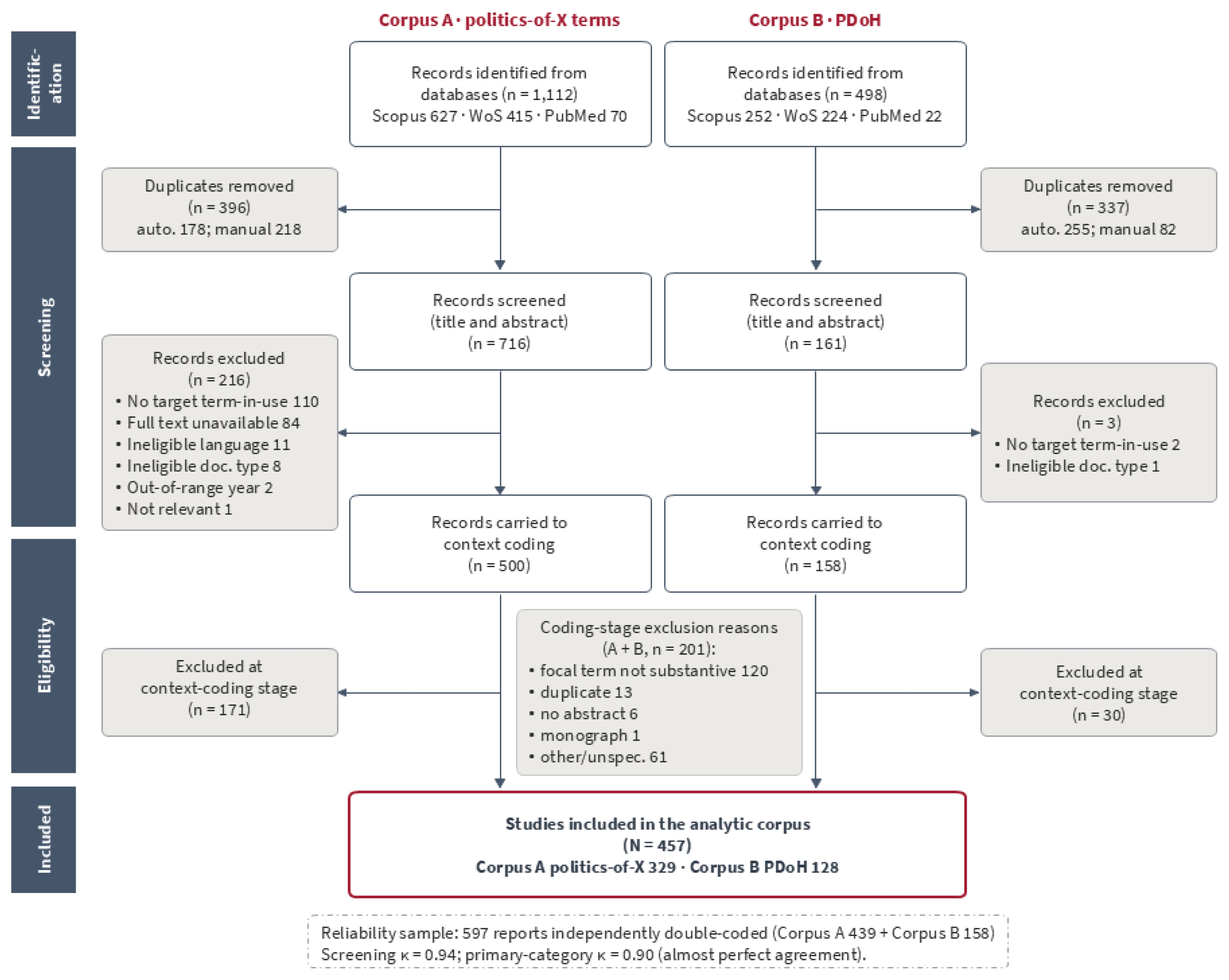
Figure 2
Temporal distribution of the primary conceptual categories by decade, 1976–2025 (N = 457)
Bars show each category’s share within the decade (100% stacked, left axis). The overlaid lines show, on the right axis, the total number of included records per decade and the counts for each corpus (politics-of-X, Corpus A; political determinants of health, Corpus B). Warm hues denote structural and critical categories (critical power analysis, political economy and welfare state, governance and accountability) and cool hues agential and process categories (policy process, interest group politics, social movements), following the Dimension 1 contrast in
Figure 4. The earliest decades contain few records, so their shares should be read with caution. The final decade (2016–2025) includes one early-access record dated 2026.
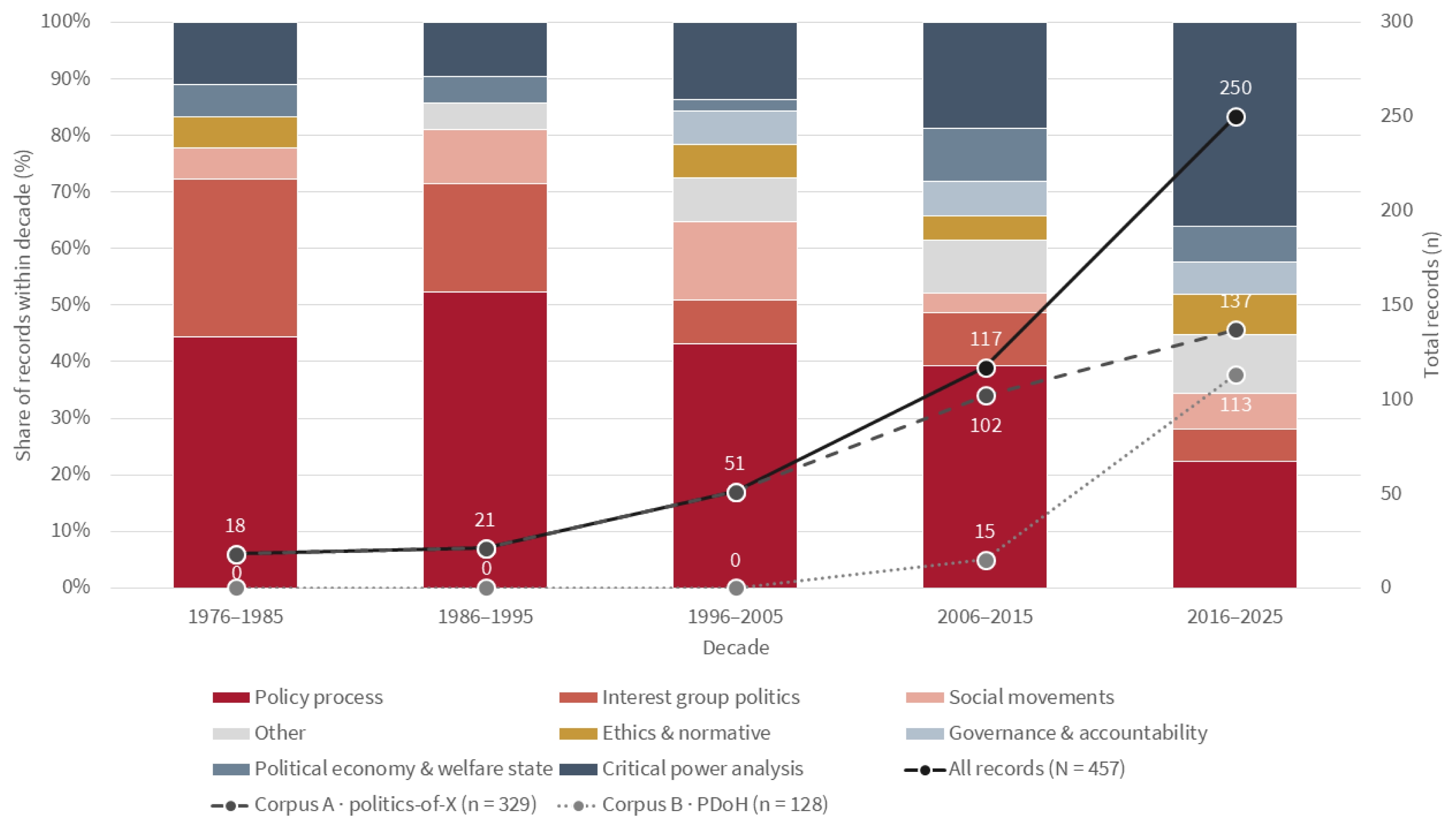
Figure 3
Focal term form × context code
Cells show the row percentage of records in each category within each term form (n included shown at right); darker shading indicates higher concentration.
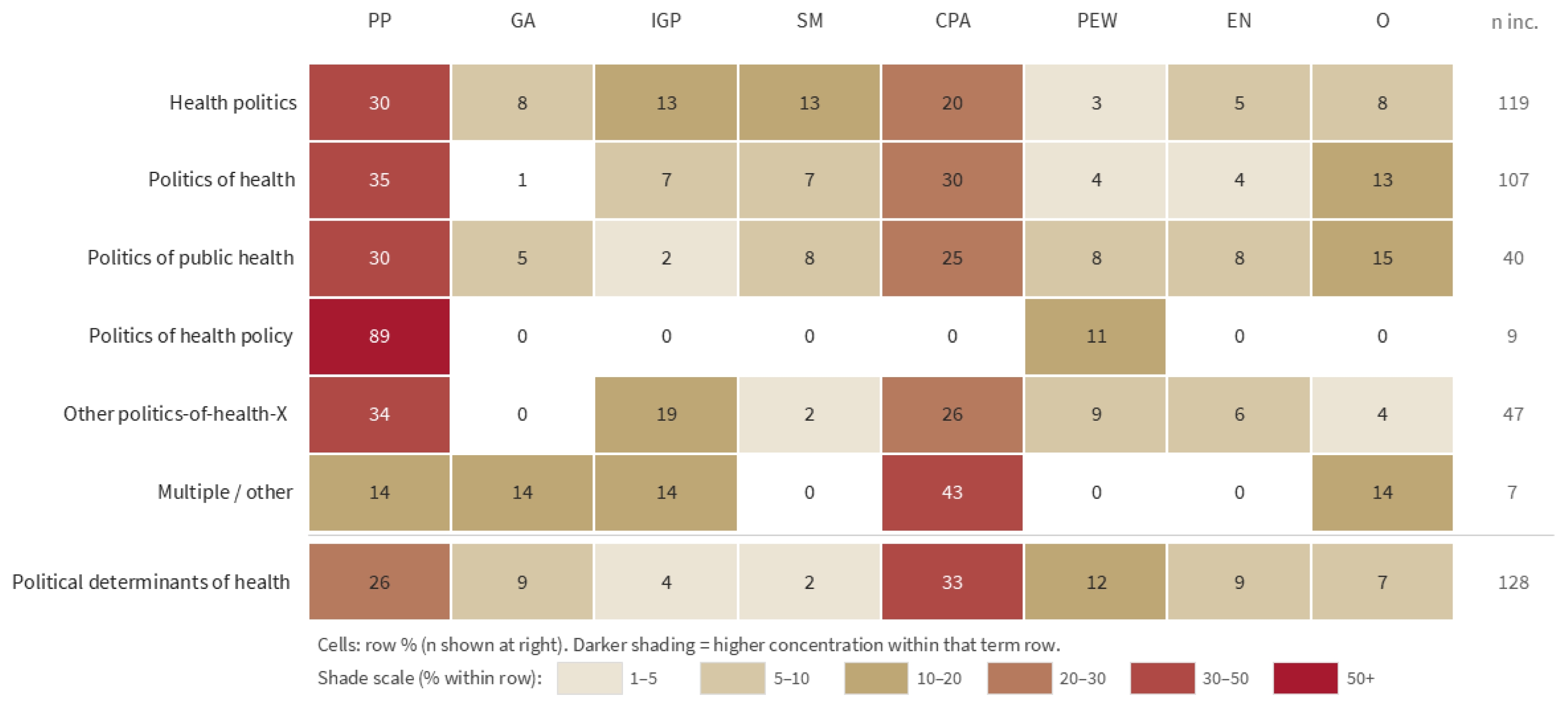
Figure 4
Multiple correspondence analysis of context coding (N = 457)
Dimension 1 (10.1%) contrasts agential/process with structural/critical conceptualizations. Dimension 2 (8.8%) contrasts applied/policy-instrumental with conceptual/exploratory usage. Filled points denote definitional pieces. Categories are ordered by conceptual grouping in the tables and the other figures. Here they are positioned by their empirical Dimension 1 coordinates.
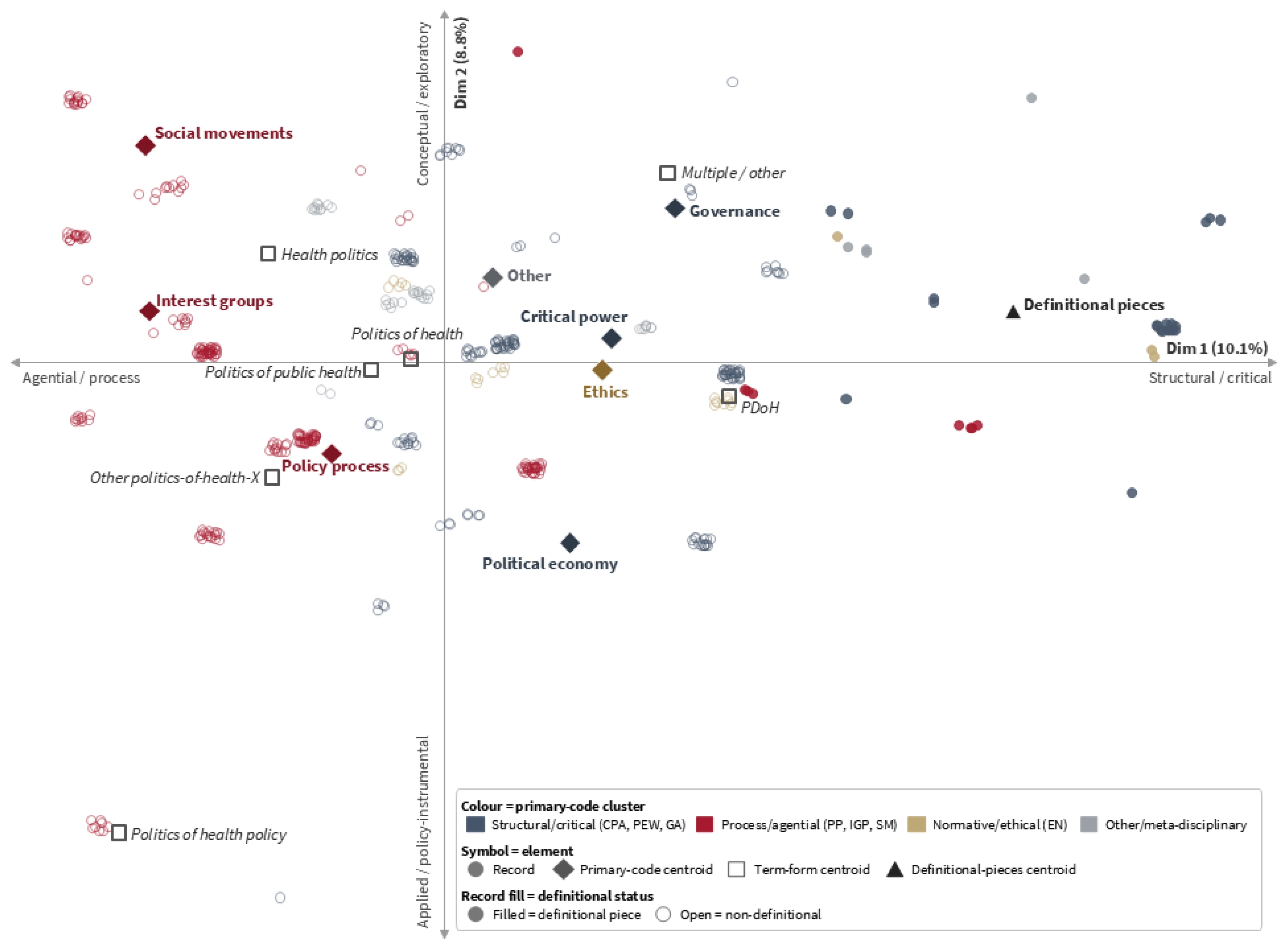
Table 1Bibliographic and conceptual characteristics of the analytic corpus, by corpus (N = 457)
Table 1
|
Characteristic |
Politics-of-X terms (n = 329) |
PDoH (n = 128) |
Total (N = 457) |
|
Focal term form, n (%)
|
|
Health politics |
119 (36.2) |
— |
119 (26.0) |
|
Politics of health |
107 (32.5) |
— |
107 (23.4) |
|
Politics of public health |
40 (12.2) |
— |
40 (8.8) |
|
Other politics-of-health-X |
47 (14.3) |
— |
47 (10.3) |
|
Politics of health policy |
9 (2.7) |
— |
9 (2.0) |
|
Multiple / other |
7 (2.1) |
— |
7 (1.5) |
|
Political determinants of health |
— |
128 (100) |
128 (28.0) |
|
Definitional piece, n (%)
|
|
Yes |
14 (4.3) |
22 (17.2) |
36 (7.9) |
|
No |
315 (95.7) |
106 (82.8) |
421 (92.1) |
|
Primary conceptual category, n (%)
|
|
Policy process |
110 (33.4) |
33 (25.8) |
143 (31.3) |
|
Governance & accountability |
13 (4.0) |
11 (8.6) |
24 (5.3) |
|
Interest group politics |
33 (10.0) |
5 (3.9) |
38 (8.3) |
|
Social movements |
28 (8.5) |
2 (1.6) |
30 (6.6) |
|
Critical power analysis |
81 (24.6) |
42 (32.8) |
123 (26.9) |
|
Political economy & welfare state |
15 (4.6) |
15 (11.7) |
30 (6.6) |
|
Ethics & normative |
16 (4.9) |
11 (8.6) |
27 (5.9) |
|
Other |
33 (10.0) |
9 (7.0) |
42 (9.2) |
References
- Arksey, H., & O’Malley, L. (2005). Scoping studies: Towards a methodological framework. International Journal of Social Research Methodology, 8(1), 19–32. https://doi.org/10.1080/1364557032000119616
- Aromataris, E., & Munn, Z. (Eds.). (2020). JBI manual for evidence synthesis. JBI. https://doi.org/10.46658/JBIMES-20-01
- Atti, E., & Gulis, G. (2017). Political determinants of progress in the MDGs in Sub-Saharan Africa. Global Public Health, 12(11), 1351–1368. https://doi.org/10.1080/17441692.2016.1177567
- Bachrach, P., & Baratz, M. S. (1962). Two faces of power. American Political Science Review, 56(4), 947–952. https://doi.org/10.2307/1952796
- Bambra, C. (2011). Work, worklessness, and the political economy of health. Oxford University Press.
- Bambra, C., Fox, D., & Scott-Samuel, A. (2007). A politics of health glossary. Journal of Epidemiology and Community Health, 61(7), 571–574. https://doi.org/10.1136/jech.2006.046128
- Beckfield, J., & Krieger, N. (2009). Epi + demos + cracy: Linking political systems and priorities to the magnitude of health inequities—Evidence, gaps, and a research agenda. Epidemiologic Reviews, 31(1), 152–177. https://doi.org/10.1093/epirev/mxp002
- Brown, P., Zavestoski, S., McCormick, S., Mayer, B., Morello-Frosch, R., & Gasior Altman, R. (2004). Embodied health movements: New approaches to social movements in health. Sociology of Health & Illness, 26(1), 50–80. https://doi.org/10.1111/j.1467-9566.2004.00378.x
- Brugger, F., Proksik, J. J., Cambaço, O., Lyatuu, I., Adongo, P., Ayanore, M. A., & Winkler, M. S. (2025). ‘Knowing how the machine works’: A novel framework for engaging with the political determinants of health. BMJ Global Health, 10(8), https://doi.org/10.1136/bmjgh-2025-019640
- Carpenter, D. (2012). Is health politics different?. Annual Review of Political Science, 15, 287–311. https://doi.org/10.1146/annurev-polisci-050409-113009
- Chung, H., & Muntaner, C. (2026). Why health politics? Power, institutions, and the political determinants of health in an age of converging crises. Health Politics, 1(1), e002. https://doi.org/10.66534/hp.2026.0002
- Collier, D., & Mahon, J. E. Jr (1993). Conceptual “stretching” revisited: Adapting categories in comparative analysis. American Political Science Review, 87(4), 845–855. https://doi.org/10.2307/2938818
- Daniels, N. (2008). Just health: Meeting health needs fairly. Cambridge University Press.
- Dawes, D. E. (2018). The future of health equity in America: Addressing the legal and political determinants of health. Journal of Law, Medicine & Ethics, 46(4), 838–840. https://doi.org/10.1177/1073110518821976
- Dawes, D. E. (2020). The political determinants of health. Johns Hopkins University Press.
- de Leeuw, E., Clavier, C., & Breton, E. (2014). Health policy—Why research it and how: Health political science. Health Research Policy and Systems, 12, 55. https://doi.org/10.1186/1478-4505-12-55
- Esping-Andersen, G. (1990). The three worlds of welfare capitalism. Princeton University Press.
- Fischer, T., Mauer, N., & Tille, F. (2024). A framework for studying EU health policy through a political determinants of health lens: The case of the European Health Union. Journal of Health Politics, Policy and Law, 49(5), 691–720. https://doi.org/10.1215/03616878-11257056
- Foucault, M. (1978). The history of sexuality, Vol.1: An introduction. Pantheon Books.
- Fox, A. M., & Reich, M. R. (2015). The politics of universal health coverage in low- and middle-income countries: A framework for evaluation and action. Journal of Health Politics, Policy and Law, 40(5), 1023–1060. https://doi.org/10.1215/03616878-3161198
- Goertz, G. (2006). Social science concepts: A user’s guide. Princeton University Press.
- Gomez-Vidal, C., Palmer, A. N., Kitchens, K., Ratliff, G. A., & Graaf, G. (2024). Unincorporation in counties as a political determinant of health: An exploration of five states. SSM – Population Health, 28, 101728. https://doi.org/10.1016/j.ssmph.2024.101728
- Gramsci, A. (1971). Selections from the prison notebooks. International Publishers.
- Greer, S. L., Bekker, M. P. M., Azzopardi-Muscat, N., & McKee, M. (2018). Political analysis in public health: Middle-range concepts to make sense of the politics of health. European Journal of Public Health, 28(suppl_3), 3–6. https://doi.org/10.1093/eurpub/cky159
- Greer, S. L., Vasev, N., Jarman, H., Wismar, M., & Figueras, J. (2019). It’s the governance, stupid! TAPIC: A governance framework to strengthen decision making and implementation (European Observatory Policy Brief No 33). World Health Organization Regional Office for Europe (European Observatory on Health Systems and Policies).
- Greer, S. L., Wismar, M., & Figueras, J. (Eds.). (2016). Strengthening health system governance: Better policies, stronger performance. Open University Press.
- Jones, D. K. (2019). Political participation in the least healthy place in America: Examining the political determinants of health in the Mississippi Delta. Journal of Health Politics, Policy and Law, 44(3), 505–531. https://doi.org/10.1215/03616878-7367048
- Kickbusch, I. (2015). The political determinants of health—10 years on. BMJ, 350, h81. https://doi.org/10.1136/bmj.h81
- Krieger, N., Moallef, S., Chen, J. T., Balasubramanian, R., Cowger, T. L., Hamad, R., McGregor, A. J., Hanage, W. P., Tabb, L. P., & Bassett, M. T. (2024). Politicians, power, and the people’s health: US elections and state health outcomes, 2012–2024. Health Affairs Scholar, 2(12), qxae163. https://doi.org/10.1093/haschl/qxae163
- Landis, J. R., & Koch, G. G. (1977). The measurement of observer agreement for categorical data. Biometrics, 33(1), 159–174. https://doi.org/10.2307/2529310
- Levac, D., Colquhoun, H., & O’Brien, K. K. (2010). Scoping studies: Advancing the methodology. Implementation Science, 5, 69. https://doi.org/10.1186/1748-5908-5-69
- Lukes, S. (2005). Power: A radical view (2nd ed). Palgrave Macmillan.
- Mackenbach, J. P. (2019). Health inequalities: Persistence and change in European welfare states. Oxford University Press.
- Mahoney, J., & Thelen, K. (Eds.). (2010). Explaining institutional change: Ambiguity, agency, and power. Cambridge University Press.
- McKee, M., & Stuckler, D. (2018). Revisiting the corporate and commercial determinants of health. American Journal of Public Health, 108(9), 1167–1170. https://doi.org/10.2105/AJPH.2018.304510
- Merton, R. K. (1968). Social theory and social structure (Enlarged ed.). Free Press.
- Muntaner, C., Borrell, C., Ng, E., Chung, H., Espelt, A., Rodríguez-Sanz, M., Benach, J., & O’Campo, P. (2011). Politics, welfare regimes, and population health: Controversies and evidence. Sociology of Health & Illness, 33(6), 946–964. https://doi.org/10.1111/j.1467-9566.2011.01339.x
- Navarro, V. (Ed.). (2007). Neoliberalism, globalization, and inequalities: Consequences for health and quality of life. Baywood.
- Navarro, V., & Muntaner, C. (Eds.). (2004). Political and economic determinants of population health and well-being: Controversies and developments. Baywood.
- Nayak, S. S., Fraser, T., Aldrich, D. P., Panagopoulos, C., & Kim, D. (2024). County-level political group density, partisan polarization, and individual-level mortality among adults in the United States: A lagged multilevel study. SSM – Population Health, 26, 101662. https://doi.org/10.1016/j.ssmph.2024.101662
- Olson, M. (1965). The logic of collective action: Public goods and the theory of groups. Harvard University Press.
- Ottersen, O. P., Dasgupta, J., Blouin, C., Buss, P., Chongsuvivatwong, V., Frenk, J., Fukuda-Parr, S., Gawanas, B. P., Giacaman, R., Gyapong, J., Leaning, J., Marmot, M., McNeill, D., Mongella, G. I., Moyo, N., Møgedal, S., Ntsaluba, A., Ooms, G., Bjertness, E., & Scheel, I. B. (2014). The political origins of health inequity: Prospects for change. The Lancet, 383(9917), 630–667. https://doi.org/10.1016/S0140-6736(13)62407-1
- Powers, M., & Faden, R. (2006). Social justice: The moral foundations of public health and health policy. Oxford University Press.
- Sabatier, P. A., & Weible, C. M. (Eds.). (2014). Theories of the policy process (3rd ed). Westview Press.
- Sartori, G. (1970). Concept misformation in comparative politics. American Political Science Review, 64(4), 1033–1053. https://doi.org/10.2307/1958356
- Schattschneider, E. E. (1960). The semisovereign people: A realist’s view of democracy in America. Holt, Rinehart, Winston.
- Tarrow, S. (2011). Power in movement: Social movements and contentious politics (3rd ed). Cambridge University Press.
- Tilly, C., & Tarrow, S. (2015). Contentious politics (2nd ed). Oxford University Press.
- Tricco, A. C., Lillie, E., Zarin, W., O’Brien, K. K., Colquhoun, H., Levac, D., Moher, D., Peters, M. D. J., Horsley, T., Weeks, L., Hempel, S., Akl, E. A., Chang, C., McGowan, J., Stewart, L., Hartling, L., Aldcroft, A., Wilson, M. G., Garritty, C., & Straus, S. E. (2018). PRISMA Extension for Scoping Reviews (PRISMA-ScR): Checklist and explanation. Annals of Internal Medicine, 169(7), 467–473. https://doi.org/10.7326/M18-0850
- Walt, G., & Gilson, L. (1994). Reforming the health sector in developing countries: The central role of policy analysis. Health Policy and Planning, 9(4), 353–370. https://doi.org/10.1093/heapol/9.4.353